Available through our distributors:
Distributors list coming soon

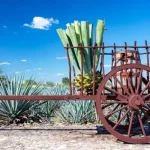
You will discover the History of Tequila, How Tequila Was Invented, Tequila Name Origin, What Agave Tequilana Weber Is, and the Denomination of Origin.
In this article, you will find:
The origin of tequila dates back to pre-Hispanic times when the Aztecs and other indigenous peoples of Mexico produced a fermented drink called “pulque.” Pulque was obtained from the fermentation of aguamiel, the sweet liquid extracted from the heart of the maguey plant (also known as agave).
The maguey was considered a sacred plant for the Aztecs, playing a significant role in their mythology and culture.
Pulque was not only a ritualistic drink but also a symbol of life and divinity. The Aztecs believed that maguey had healing and nutritional properties, and pulque was consumed in religious ceremonies and festivals.
With the arrival of the Spaniards in Mexico in the 16th century, the distillation process was introduced, eventually leading to the creation of tequila as we know it today. Distillation allowed producers to obtain a stronger and concentrated liquor from fermented agave juices.
This liquor, known as “mezcal de Tequila,” evolved over time and became the tequila produced in the Jalisco region and parts of surrounding states.
The name “tequila” comes from the Tequila region in the state of Jalisco, Mexico, where the tequila industry has developed for centuries. Commercial production of tequila began in the late 19th century.
The term “tequila” as the name of the beverage has been used for a long time, but formal production and marketing of tequila, under specific regulations, began with the creation of the Denominación de Origen del Tequila in the 1970s.
This Denominación de Origen establishes specific regions in Mexico where true tequila can be produced and sets quality standards for the production of the beverage.
Tequila is primarily produced from the blue agave variety, also known as Agave tequilana Weber. This agave takes several years to mature before it can be harvested and used for tequila production. The plant is harvested, cooked to release sugars, fermented, and then distilled to create tequila.
Tequila is an iconic Mexican beverage and one of the most recognized internationally. It is protected by the Denominación de Origen, meaning it can only be produced in certain regions of Mexico, mainly in Jalisco and parts of the states of Guanajuato, Michoacán, Nayarit, and Tamaulipas.
The term “Agave” is derived from the Greek “agavos,” meaning “noble” or “admirable.” This name is attributed to the majesty and resilience of the agave plant, which can survive in arid and harsh conditions. The choice of this name reflects the remarkable characteristics of the plant and its historical and cultural importance in the regions where it is cultivated.
The name Agave has been used since the binomial classification system introduced by the Swedish botanist Carl Linnaeus in the 18th century. The agave plant, from which nectar is extracted to make pulque and tequila, belongs to the genus Agave. There are many different species of agave, each with its own specific characteristics and uses.
Carl Linnaeus is known as the father of modern taxonomy and developed the binomial classification system, where each species is identified by two Latin terms: the first is the genus and the second is the specific epithet. In the case of agave, the genus name is “Agave,” and the specific epithet varies according to the species of agave in question.
So, to refer to a particular species of agave scientifically, the genus name (Agave) would be used, followed by the specific epithet corresponding to that particular species. For example, for the blue agave, whose full scientific name is Agave tequilana, “Agave” is the genus, and “tequilana” is the specific epithet. This nomenclature allows precise and universal identification of plant species in the scientific world.
The name “Weber” in Agave tequilana Weber is a tribute to the German botanist Franz Weber, who made significant contributions to the study of agaves and their taxonomy in the 19th century.
Agave tequilana Weber, commonly known as blue agave or agave tequilana, is the agave species primarily used in tequila production. It is a succulent plant belonging to the Asparagaceae family and is native to Mexico, where it is cultivated in specific regions for the production of this famous spirit.
This agave species is valued for its high sugar content, especially in the plant’s core, which is used to produce the fermented must from which tequila is distilled.
Since the implementation of the Denominación de Origen, tequila has gained worldwide recognition as an authentic and high-quality beverage. The protection of the Denominación de Origen has been instrumental in the growth and reputation of the tequila industry worldwide.
It is essential to emphasize that tequila is a product with Controlled Denomination of Origin, meaning it can only be produced in certain geographical areas of Mexico and must comply with specific standards and regulations to bear the name “tequila.” This regulation guarantees the authenticity and quality of the tequila produced in Mexico.

