Available through our distributors:
Distributors list coming soon

Discover how tequila is made, how it is distilled, the types of tequila, their alcohol content, and their characteristics.
In this article, you will find:
The tequila production journey starts with nurturing and cultivating the blue agave (Agave tequilana Weber).
Blue agave is planted using shoots or small plants obtained from mature plant roots. These shoots are cultivated in fields, requiring proper irrigation and care for healthy growth.
Blue agave takes several years to mature before it’s ready for harvest. During this time, the plant accumulates sugars in its core, essential for tequila production. The plant is carefully tended to protect it from pests and diseases.
Harvesting occurs when the blue agave reaches maturity, usually between 7 to 10 years old. Farmers remove the outer leaves to reveal the core, known as “agave piña” or “agave head.” This core is used for tequila production.
After harvest, agave piñas are cooked to convert starches into fermentable sugars. Traditional methods involve baking in masonry ovens for several days, although some modern producers use autoclaves for a faster process.
Cooked agave piñas are crushed to extract juice, which is then fermented to produce “mosto” (fermented juice). Crushing can be mechanical or traditional, using a tahona – a stone wheel pulled by horses or tractors – and may take several days.
The mosto is placed in fermentation tanks, where yeast is added to initiate the fermentation process. This process lasts several days, during which sugars convert to alcohol, creating a liquid called “fermented must.”
The fermented must undergoes distillation, lasting 1-2 days, to increase its alcohol content. Traditionally, distillation occurs twice in copper stills, although high-quality tequilas may undergo a third distillation.
Tequila can be aged for various durations, from months to years, creating different types:
Newly distilled tequila without oak aging. It has a fresh, pronounced agave flavor and is commonly used in cocktails like margaritas.
A general term for tequila blended with blanco or reposado, possibly containing colorings and flavors. It has a golden color and a smoother taste than blanco.
Aged in oak barrels for a minimum of two months, imparting a slightly golden color and smoothed flavors due to wood interaction.
Aged in oak barrels for at least one year, resulting in a darker color and complex flavors from prolonged wood aging.
Aged in oak barrels for over three years, with a very dark color and a smooth, complex taste, often featuring notes of vanilla and caramel.
A relatively new category involving a filtration process to remove color from añejo or extra añejo tequila while preserving its complexity, giving it a clear appearance similar to blanco.
Tequila’s quality and taste vary significantly based on the brand and the specific production process employed by the manufacturer.
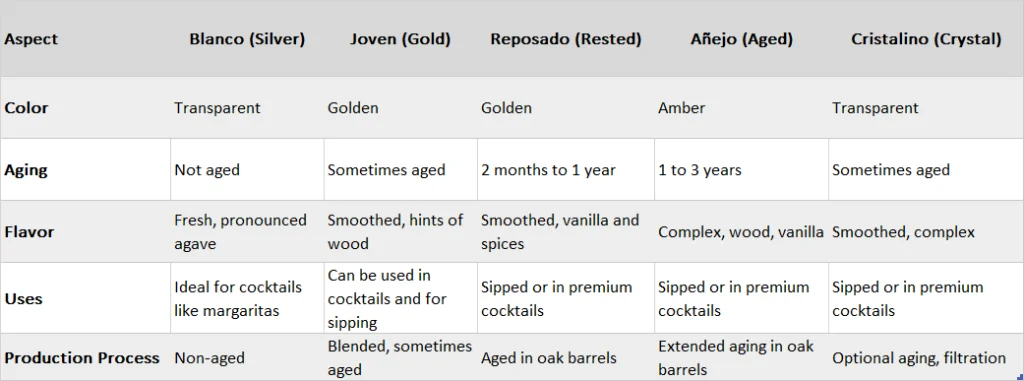
This table provides a detailed comparison of different types of tequila, highlighting their distinctive features, aging processes, flavors, and uses.
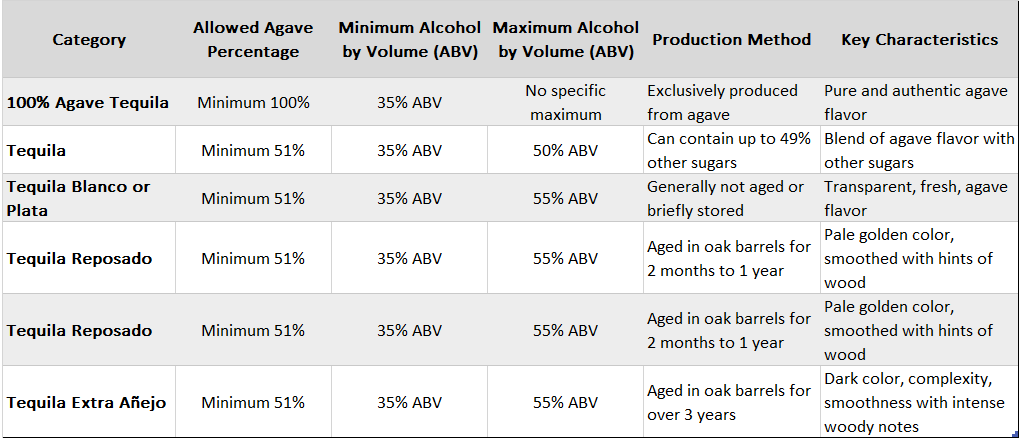
This table outlines the various categories of tequila, specifying the allowed agave content, alcohol percentages, production methods, and main characteristics of each type.
At the moment you read this article, there might have been relevant updates or modifications. It’s important to verify official channels from Mexico.

